Showing posts with label environment. Show all posts

Friday, 21 June 2013

Places we are visiting this month in the North East!


House of Objects
For four Saturdays in June, House of Objects Creative Recycling Centre at the Rising Sun will open its doors for visitors to come and explore its Aladdin’s cave of weird and wonderful recycled materials and get creative in its specialist studio space. The theme for each week will be a particular object of significance that was invented or developed in the North East. For more information click here.
NOTE - House of Objects receive old/waste/unwanted (but still useable!!) materials, so if you are a company, shop or artist clearing out your studio then get in touch with them!!

Heritage Skills Festival
Heritage Skills Festival returns to Tynemouth Station on 28th-30th June, offering visitors a chance to try their hand at a wide range of heritage crafts such as stonemasonry, green woodworking, blacksmithing, lime mortar, leather working and much, much more.  Working with professionals, you’ll also get the opportunity to get advice and learn more about the heritage of the North East. Event information

Baltic Artist’s Book Fair
Festival of the North East event – the artist’s book fair at the Baltic in Gateshead, on 14th & 15th June.  further info 

Tuesday, 14 May 2013

Skyping Lima - update!

We held the skype session between Newcastle University 2nd year Fine Art students and Pontificia Universidad Catolica del Peru Industrial Design and Graphic Design students on Friday 3rd May.

The session allowed the students to hold a live discussion based around their own art work, how their course is structured and what they plan to do after uni. Suzanne gave an overview of the Transporter project and why we were working with the 2nd year students, Kitty Langton (student) gave an overview of the 'Strand' module and what they had learnt so far and how it was helping them develop their artwork and Ella Dorton (student) gave an overview of the Fine Art course and how it is taught in England.

This led onto the Lima students giving an overview of their projects and they both compared the differences with the courses i.e. lima study for 5-6 years and specialise in a specific artform and are not able to work cross artforms like in England. Lima students however have a much stronger focus on learning their skill and perfecting their craft before focussing on their own personal ideas development whereas Newcastle students are much more focussed on the concepts of their artwork and tend to learn specific skills as and when they need to.

The students asked specific questions about each others work and posted comments on the Flickr site which you can find here - http://www.flickr.com/photos/67813410@N05/

We are keen to explore the potential for students to take part in an exchange at each other's universities so that they can benefit from the different approaches to art courses.


regards
Transporter project!!

Thursday, 28 March 2013

Interesting projects!

Hello again, a quick update from the Transporter Project with a list of projects and websites which you may be interested in....

A great community project building a greenhouse from plastic bottles
http://www.the4csne.com/greenhouse.html

Go back to basics and make your own book!
http://theresaeaston.wordpress.com/2013/03/13/print-book-making-36-lime-street/

Uniting new and old technologies, Yvette Hawkins and Susannah Pickering - whose work incorporates books, poetry and traditional crafts - will start a poem thread on Twitter with clothing as the central theme.
http://www.bookapothecary.co.uk/#!blog/cs0g

An interesting article about sustainability
http://www.guardian.co.uk/culture-professionals-network/culture-professionals-blog/2013/mar/18/environment-reporting-arts-council-sustainability

Northeast Permaculture - Since January 2005, permaculture activists throughout the Northeast have been meeting and actively creating a network for mutually supporting each other and advancing permaculture solutions among the wider public in our area
http://northeasternpermaculture.wikispaces.com/

A link to a great project one of our Newcastle University Fine art students recently attended
http://www.felinuchaf.org/

Enjoy the Easter Weekend!
Transporter Project

Friday, 22 March 2013

Newcastle University 'Strand' Project


We are working with 15 Newcastle University 2nd yr Fine Art students as part of our creative exchange element of the Transporter project. The 'Strand' project, which runs alongside the students studio practice, allows us to share information, knowledge and skills learnt during our time in Peru and Berlin (as well as the developments within our arts practices), with the students to help them develop ideas and new skills.


They’ve had some great ideas and are inspiring us with new ideas too- we are encouraging the students to learn a new skill or develop a body of research on a new area during the Strand. They are responding well to this and some are integrating the project into their studio practice as they discover a new interest or area they wish to work in.

We are uploading images of the students work onto our flickr photostream so please have a look and comment to give them feedback on their ideas so far! http://www.flickr.com/photos/transporterproject/sets/72157633054505042/ Any signposts to artists, books etc to help them with their research is welcomed too!

The Student project aims and learning outcomes are - 

•Develop an understanding of different crafts and skills, what role they play in cultural heritage and whether they can inspire contemporary art
•Gain a greater understanding of other art forms
•Experiment and collaborate with other artists/peers.
•Learn, share skills in arts and crafts such as weaving, paper making, pottery, woodwork etc
•Learn new ways of seeing and doing through cultural exchange and researching their own cultural heritage
•Understand issues surrounding sustaining local and international traditional art forms and cultures
•Develop understanding of sustainable arts practise and broader environmental issues
•Question and explore their relationship to their environment.
•Self direct their studies and research
•Group work and critical feedback
•Create a body of research, ideas and experiments which explore new ground for the student
•Create a ‘resolved’ new art work/design/prototype (either individually or collaboratively) for public showing.


Tuesday, 4 December 2012

SOAPBOX at BALTIC Centre for Contemporary Arts


We were recently invited to deliver a talk at Baltic as part of the programme for The Encampment of Eternal Hope, which is a major new sculptural installation by Zoë Walker & Neil Bromwich. The exhibition 'extends their enquiry into the role of art as an active agent for transformation in society.  Taking apocalyptic predictions for 21 December 2012, the end date for the Mayan Calendar, as an imaginative catalyst, the project envisages a post-apocalyptic utopian community, a kind of ‘garden of earthly delights’.

Our talk was part of Soapbox events where 'diggers, dreamers, survivalists, optimists, pessimists, slackers, thinkers, doers, creatives, philosophisers, alternative life stylers, environmentalists, freeganers..... could step up on The Encampment of Eternal Hope Soap Box and help shape a better world.' People could voice their opinions, demonstrate a survival skill, create an event, speak, sing, perform or meditate to show how can we live in a better way with our environment and our fellow beings.

SO... we decided to talk about the Transporter project and invited people to answer questions to contribute to our research. We also had a discussion with the audience after our presentation which was really interesting and covered subjects which ranged from; guerrilla gardening, the disconnection of man and nature and specifically the waste which artists create when making work and whether pieces/materials should be reused/remade in an effort to be more sustainable. We also discussed up-cycling waste materials and whether it is more interesting to try and recreate something which disguises the materials' former use (such as creating something using plastic bottles which doesn't scream 'plastic bottle sculpture') and also the boundary between a functional object, craft and art.


Here is a copy of our soapbox script! We'd also invite you to comment on the blog post with your answers to the questions at the end...

'We are here today, not because we know much about Mayan culture or that we believe the world will end on the 21st December but that we are interested in the Encampment project and how it is highlighting different, creative ways of living and questioning how connected we feel to the world, Mother Nature and the environment. The idea of being more ‘in tune’ with the world around us and being more resourceful is something that appeals to us and connects to our philosophies we have currently been developing within our own art work.

In 2010 we had a discussion about the fact that, although we called ourselves artists, and sculptors, we hadn’t crafted or made anything with our hands for a very long time. We decided that we wanted to learn more about making, working with materials and being more resourceful. We wanted to learn and improve as artists and share these skills and knowledge with others- the way it used to be in cultures when stories, skills and crafts were passed from one generation to the next. It is this interest in getting back to basics, valuing tradition, learned art forms, being resourceful by working with the environment around us that has led to the development of our TRANSPORTER project.


TRANSPORTER is a multi cultural creative project and involves the exchanging and transporting of creative skills, ideas and crafts. It aims to highlight the idea of sustainable arts practise, looking at people’s relationship to their environment and the value of cultural heritage. As part of our research in 2011 we worked at an eco village in Northern Peru and learn traditional craft and building skills. In 2012 we worked in an art waste resource centre in Berlin and made art using only scrap materials.
At this stage, the Transporter project is covering broad subject matter of sustainability, the environment and traditional skills and knowledge which will be further defined and explored as the project and the artist’s interests develop. Transporter has its own blog and flickr websites as a Knowledge Bank to document the skills, crafts and ideas discovered by the project so far- anyone can access this. Sessions are delivered with universities, groups and other artists as a way to pass on knowledge and skills learnt whilst developing the artists. 

As further research for Transporter we’d like to ask you some questions which will help us gain insight into your point of view on creativity, resourcefulness and waste. It would be great if you could take part by answering the questions on the wall. Maybe the 21st December could mark the beginning of a more sustainable, thoughtful and resourceful era rather than the end of the world!'


QUESTIONS:
How resourceful do you think you are on a scale 1-6?
What have you reused/up-cycled recently instead of throwing out - and what was its new function? What was the last thing you made with your hands and your imagination?
What do you throw away the most of?

Thursday, 18 October 2012

CREATIVE EXCHANGE @ HIGHGREEN, TARSET Part 2


 CREATIVE EXCHANGE @ HIGHGREEN, TARSET : EXPLORING CRAFT, CULTURE & THE ENVIRONMENT

As part of the TRANSPORTER project, artists and curators Suzanne Hutton and Sam Taylor will be facilitating a second skill sharing and making workshop on Saturday 3rd November 2012, 10-4pm which explores how contemporary art can be developed from traditional skills and craft and through the reusing of waste or discarded materials, looking at the theme of sustainability.

Sam and Suzanne will talk about the Transporter project, highlighting their recent artist residency at Kunst Stoffe in Berlin, an arts resource centre dedicated to an artistic, aesthetic and sociological exploration of reusing waste and discarded materials and presenting their current practice as a result of this residency.

Participants will share their own skills and develop new work in the peaceful surroundings of Highgreen. We encourage you to bring your own waste materials and something to the session so that we can learn from you too! This could be an idea or a material you are currently working with or a piece of work to show others. The aim of the session is to develop your own creative practice by working with new materials or pushing your current ideas about craft and art.

Note: Some materials will be provided. Refreshments will be provided but please bring lunch.
Car share is available from Newcastle/Gateshead –please just ask!

FREE but booking essential TO BOOK: Email suzanne.hutton@gmail.com or call Suzanne on 07900 147628 or call Janet (VARC) on 01434 240822
TRANSPORTER was devised by artists Suzanne Hutton and Sam Taylor as a way to learn and improve as artists whilst sharing skills and knowledge with others- it looks across wide subject areas such as sustainability, the environment, craft/skills and how these differ and compare across cultures. The project will develop as the artists develop. Transporter has its own blog and flickr websites which document the skills, crafts and ideas discovered by the project so far: www.transporterproject.blogspot.com | www.flickr.com/photos/67813410@N05/sets/

The Transporter project is supported by Arts Council England.
This workshop is held in association with VARC (Visual Arts in Rural Communities) and with thanks also to Highgreen Estate for providing the venue.

Tuesday, 18 September 2012


Invitation/Press Release to our Exhibition opening as part of the Kunst Stoffe AiR programme...

Waste and Habits
Thursday | 20 September 2012 | 7pm
Opening hours 21-25th September, 11am-6pm
Museum Lichtenberg in the Town House - Victorian Kitchen Gallery | Türrschmidtstr. 24 | 10317 Berlin | S Nöldnerplatz

Kunst Stoffe presents the third exhibition of this year's artists-in-residence programme
The two artists Samantha Taylor and Suzanne Hutton from the UK to explore the potential of reuse, revise and re-presentation of everyday materials. They create models and prototypes, exclusively using materials from the Kunst Stoffe materials warehouse. Their resulting prototypes for urban landscapes, shelters, seating and contemplative spaces aim to investigate the possible and impossible harmony between the natural and the man-environment.

For more information see Kunst Stoffe website and see exhibition images here


Friday, 31 August 2012

Our first week in Berlin....


We have been in residence at Kunst Stoffe for a week now and already feel inspired by the urban landscape, history of the different districts and the general relaxed attitude to life here. We are staying in Prenzlauer Berg and so far have visited the Bauhaus Museum, East Side Gallery (Berlin Wall), taken part in various workshops relating to reusing materials and preserving our environment as well as spending time taking in architecture and public art by bicycle.


When not exploring the city, we have been in the studio creating models and prototypes for various ideas which make links between Berlin and Peru. We are creating a large dome shaped sculpture out of discarded plastic, woven posters and billboard papers and an accompanying sound piece  The piece could be transported to different urban spaces where the viewer can take time out of the city underneath its canopy and listen to the orchestral sounds from the diverse nature in Peru. It is very exciting for us to realise ideas during this residency in Kunst Stoffe for sculptures and installation which were originally conceived in Peru. The interesting aspect is that the piece will (hopefully) have resonance and meaning for both places but for different reasons.


 Our artwork is all being created using the material supplied by Kunst Stoffe#s waste centre and its many rooms filled with everything from plastic toy parts and old jigsaws, to huge reams of paper, wood/metal/cloth and tile rooms filled to the brim and an abundance of electrical and domestic items. The centre is open to the public to purchase materials which are privately donated or received from large companies locally.


 We are exploring the link between nature and the urban environment and the point at which these two co-exist and will be looking to the architecture of Berlin, and its unusually high amount of green spaces (for an urban centre) and creating artwork that reflects this. We are interested in the idea of valuing the handmade, tactile approach to art making and being resourceful in order to highlight ideas around sustainability and what it means to be ‘connected’ to your environment.

Recycling is a normal part of daily life in Berlin rather than an afterthought or a 'chore' and the city has a feeling of resourcefulness and creativity that you don't necessarily see elsewhere; quirky cafes using hay bails as seating, large scale graffiti that are regarded as artwork rather than spoiling the landscape or beach cafes on top of buildings.  This could be due to the high quantity of artists, as there are disused buildings full of studios in abundance and it feels like everyone is always doing something or there is always events/festivals happening not too far away.


SEE OUR FLICKR SITE FOR MORE IMAGES...

Tuesday, 17 January 2012

Our Artwork/ New ideas - how has this developed our arts practice?

It was quite a struggle to spend lots of focused time on making artwork when there was so much to take in and adjust to in Peru. We were out of the studio for 1 week in Chazuta and also spent a lot of time organising the Lamas event, updating the blog etc. That said, the inspirational surroundings and unique culture of the place meant that you couldn’t help but want to respond creatively to it.
Land Art/Natural Sculpture: We experimented with our first land art pieces which was exciting. There was a real sense of connection between the people and the environment where we stayed and this definitely rubbed off and made you think of how disconnected we are to our plants and animals in UK. We tracked a dried up channel from the main river near our studio and installed a pink line of petals from the Palmarosa tree along where the river use to run- the contrast of the bright pink petals against the mossy green rocks looked amazing. Weirdly, 4 days before we left there was a terrible storm and the river broke its banks filling the dried up river bed and washed away our Palmarosa line. The locals said the last time the river had done this was 11yrs ago and then again 100 yrs before that!


Film/Sound work: We also captured a massive amount of film and sound footage. The jungle was so filled with life and the staggered noises of frogs, crickets, bats, dogs and cockerels created a sound piece every night! Ants and butterflies were great to try and capture too- we are going to use our footage to develop an installation which will attempt to recreate our experience.
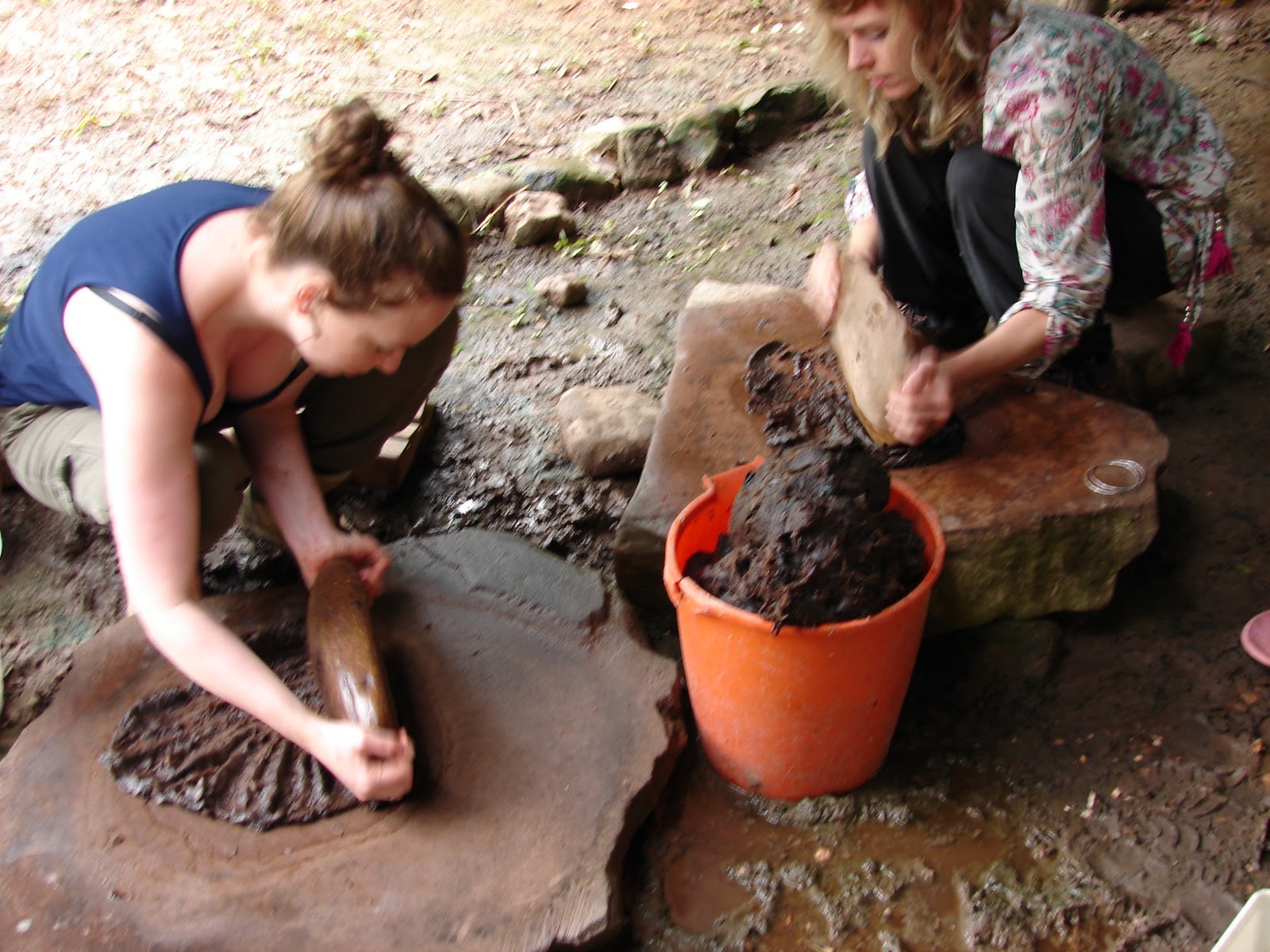
Ceramics: The potential of ceramics is also something which became clear when we worked with the ceramicists in Chazuta. It was so refreshing to be hands on with the material and we began making casts of the local environment. We want to continue this in the UK and any other travels to build up a giant clay picture of different places. We also want to explore the idea of the boundary between practical pottery or craft and when it can become art - thinking about pushing the material to its limits or creating a pot which doesn’t function as a pot etc. We are looking at sourcing clay in the UK and if there are places to collect and prepare it ourselves as the ceramicists in Chazuta do. We also used the process of making wishing pots in the plaza to interact with the local community in the village- this was an interesting experience and something the local children found intriguing!


Weaving:
We met someone in the village who wove with discarded plastic sourced from the nearby town who had ingeniously taught himself to make baskets. Chumbie weaving (colourful belts hand woven from cotton) is also a beautiful and skilful indigenous craft and both methods have inspired many ideas in us to do with weaving different materials to create vessels of some kind. We had visions of creating a giant water catcher installation.


Natural pigments: We collected lots of stones from the river which we have crushed to create painting pigments and plan to test these out back in the UK and see what we can find locally which can be used in the same way.
Paper Making: Having made our very own paper in Chazuta we are now looking to sculpt with the sheets in some way, the paper is so thick and has such a tactile quality that we are going to experiment in 3D with it to see how far we can push the material

As well as the skills and crafts we were also inspired by the people we met and worked alongside. Sachaqa Arts Centre allowed us to work alongside a variety of artists, all unique in their artforms, experiences and ideas and all of whom made our time in Peru the fantastic journey that it was.
Lena Huber is a photographer and writer from Switzerland. Lena really inspired us by her refreshing approach to life, a free spirit and one of those rare people in life that can truly be inspired and interested in anything that she comes across. http://www.sachaqacentrodearte.com/page3.php
Jaime Miranda a sculptor from Lima, Peru. Jaime recently studied at Chelsea College of Art, London and has an amazing talent as a sculptor. Jaime was a great person to talk to about anything and everything and put us in touch with some fantastic people in Lima. We really hope to work with Jaime again in the future. www.jaimemiranda.com/index.htm
Trina Brahman, painter and founder of Sachaqa Centro de Arte, originally from Bradford, England Trina was very inspirational to spend time with and allowed us to see and understand different ideas on life. Trina paints visions that she experiences using natural pigments and attributes these experiences to living in the jungle, feeling a close connection to nature is important to her work. Trina has a unique approach to painting and really believes in her art, the centre and the life she is building in the highlands of Peru with her husband Daniel Lerner and baby Jacob. http://www.sachaqacentrodearte.com/page3.php


Friday, 23 September 2011

HELLO and INTRODUCTION to theTRANSPORTER project

Hello, welcome to our blog for the Transporter Project!
We hope we can provide an interesting read for those of you who wish to follow us on our adventure - due to start officially in 2 weeks time when we'll be flying off to Peru! See below for more info.... and if you would like to see more images of our research an artwork then please follow us on flickr too


Background:
As artists having grown up during the introduction of the world wide web, the digital age and globalisation, we feel it is just as important to value and utilise the local, handmade, personal side to creativity. We know that the desire for the original and bespoke is a growing market as people begin to understand the impact mass production is having on the environment and local business. It is this interest in getting back to basics, valuing tradition, learned artforms, skilled crafts and working with the environment around us, that has led to the development of 'Transporter'. We want to look, learn and develop new work that goes back to the artist as maker and collaborate with others to raise the profile of local traditions that make an area, place, and country unique.

Overview of project:

The project will allow Suzanne Hutton and Sam Taylor to be artists in residence at Sachaqa Art Centre (SAC) in Peru and deliver an engagement programme. We will conduct research, create new work and explore sustainability; looking at customs, traditional arts practices and skills and their relationship to the environment. We will spend time with SAC's founders, their resident artists and the local communities sharing skills, knowledge and inspirations in order to develop our own arts practises. From this research and dialogue we will create new collaborative art works whilst working on a variety of other projects in Peru.
On our return to the UK we will evaluate our time, continue to develop work in the studio, curate an exhibition and related talk and deliver a number of creative sessions and presentations to artists and students at The Shed Gateshead, Gateshead College, Newcastle University and International Centre for Cultural and Heritage Studies (The En-compass Project) in order to pass on knowledge and gain feedback on what we have learnt. The idea is that this is the 1st Phase in an ongoing research project to collate information about traditional crafts, skills across the world and compare creativity within cultures, whilst highlighting issues around sustainibility and the environment. There is also a FlickR page set up called 'TRANSPORTERproject' which will hopefully act as an online sketchbook where others can comment on our finds.

Main aims of TRANSPORTER project:
• To develop our artistic practise through collaboration with artists (in residence, local artisans and community members), developing new skills in local indigenous artforms and crafts
• Develop links between young people and artists from different countries
• Share and transport knowledge between artists/communities and countries
• Learning new ways of seeing and doing through cultural exchange, researching intangible cultural heritage
• Assisting with development of eco village as a way to research and create new work
• Highlight and raise the profile of sustainable arts practise and people’s relationship to their environment.
• Experiment and promote collaboration across cultures and art form.
• Produce a publication and exhibition as a legacy
• Promote further development exploring the idea of sustainable arts practise and learning from traditions.
• Develop rednile’s international links and Factory Nights programme
This project has been funded by Arts Council England with additional support from rednile projects, Sachaqa Arts Centre Peru, VARC and Newcastle University.